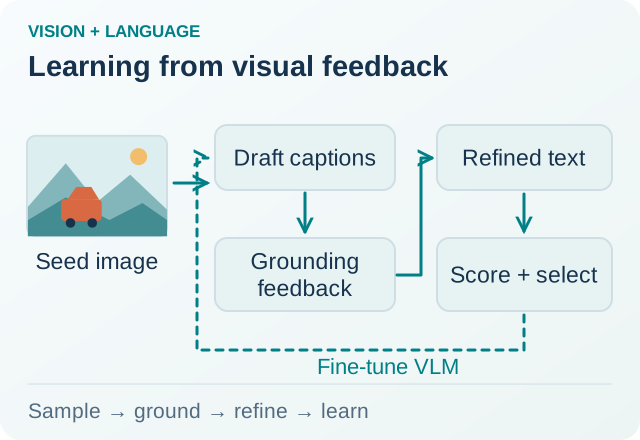
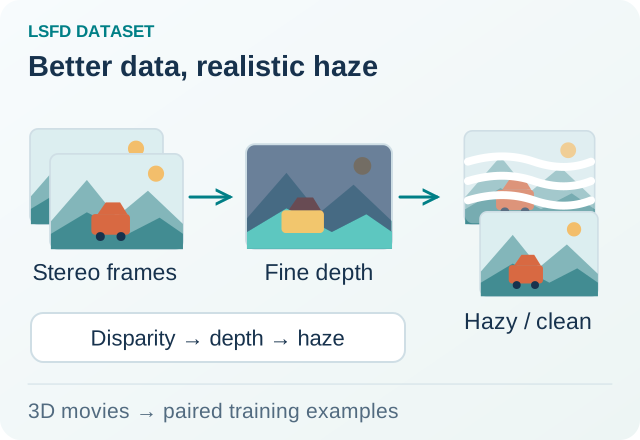
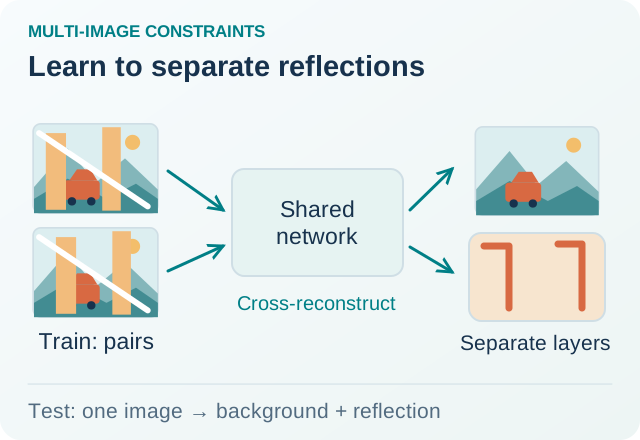
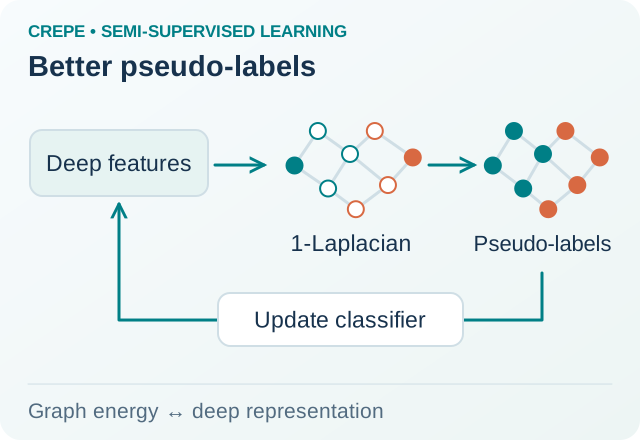
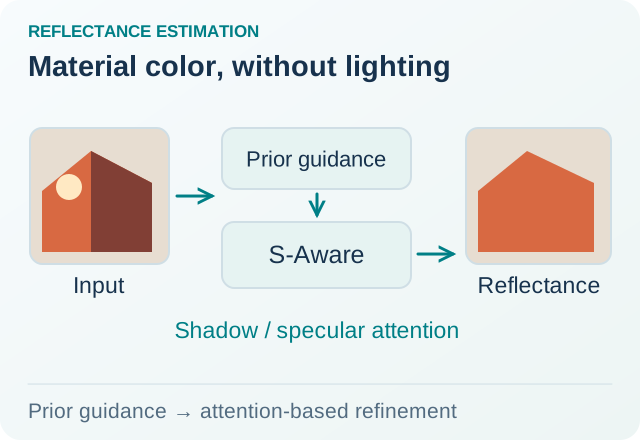
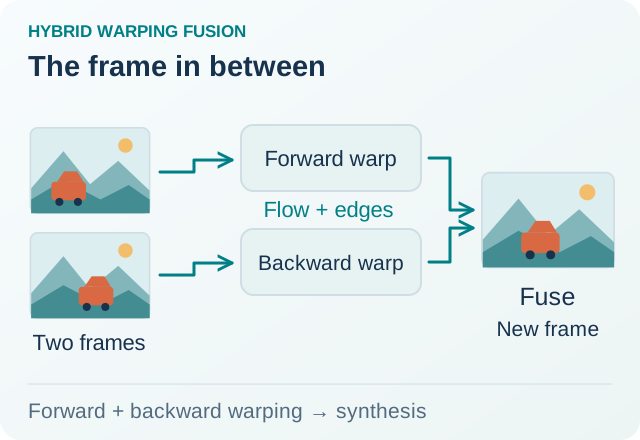
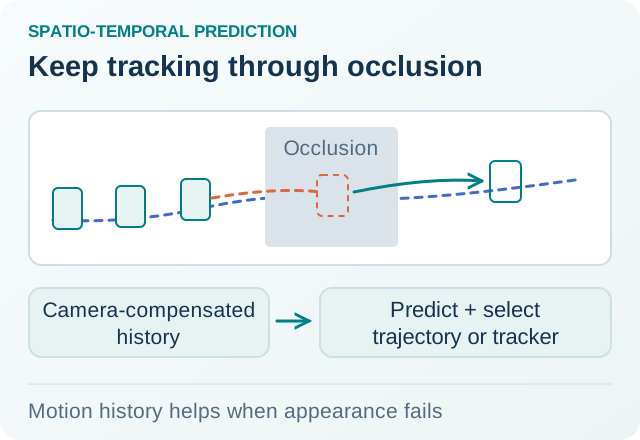
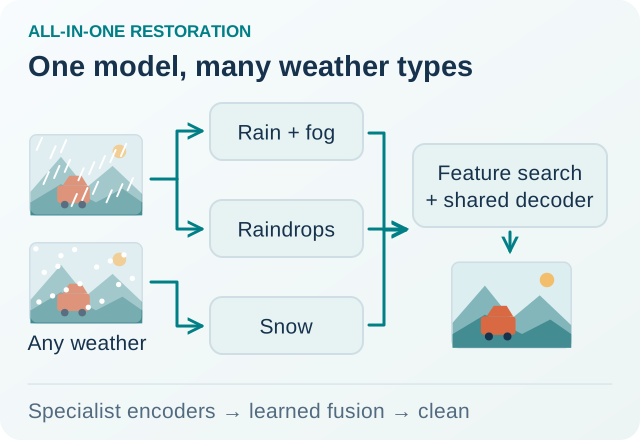
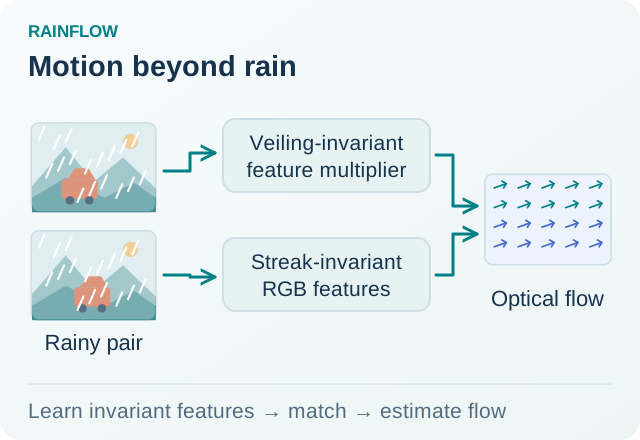
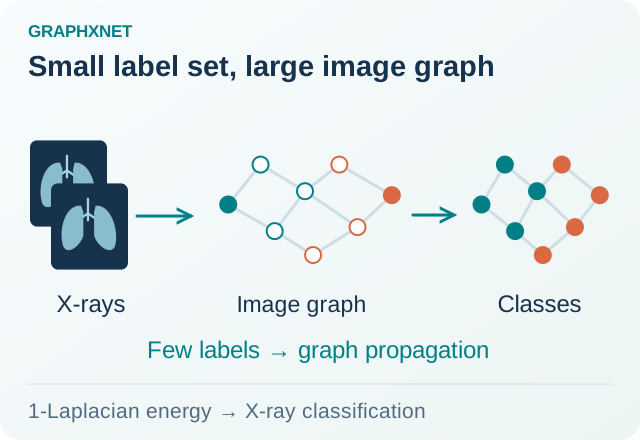
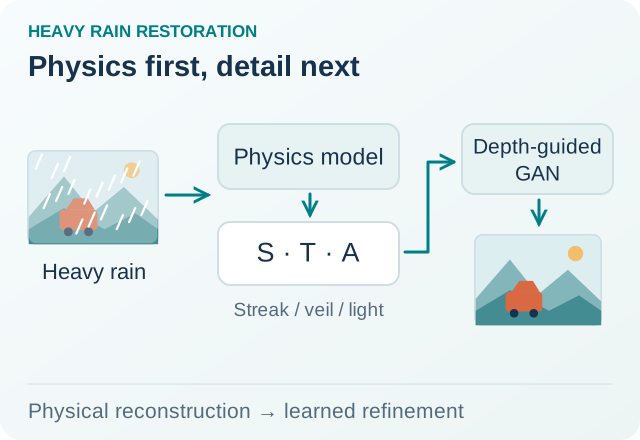
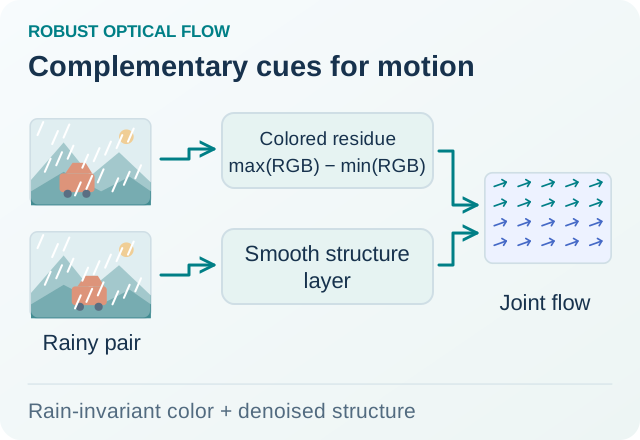
These original SVG illustrations summarize methods, rather than reproducing paper figures or portraying invented experimental outputs. Drawn directly as vectors for precise labels and arrows; no image-generation outputs are used. Each visible schematic can be opened at full size from the publication list. Original thumbnails remain in the repository.
| Asset | Source read | What the schematic represents |
|---|---|---|
| svp.svg | arXiv:2501.04568v2, §3, Figs. 7–9; accepted TMLR record | Draft captions → grounding feedback → refined text → informative sample selection → model adaptation. Grounding is feedback during sampling, not a direct box-coordinate training target. |
| dehazing.svg | arXiv:2004.08554v3, §3, Fig. 2, Algorithm 1 | Stereo movie frames → horizontal disparity and refined depth → physically rendered hazy/clean pairs. This is a dataset contribution, not a dehazing architecture. |
| reflection.svg | arXiv:1912.03623v3, §III, Figs. 2 and 4 | Shared-background image pairs constrain background/reflection separation during training through cross-reconstruction. The trained network takes only one image at inference. The thumbnail compresses latent-code switching into a shared network. |
| laplacian.svg | arXiv:1906.08635v4, §4.4–4.5, Fig. 3 | Deep features form a graph; normalized non-smooth 1-Laplacian energy infers pseudo-labels. Graph inference and classifier training alternate. Graph colors denote classes, not measured probabilities. |
| reflectance.svg | arXiv:2211.14751v3, Proposed Method, Fig. 2 | Prior-guided initial reflectance estimation, then shadow/specular-aware attention refinement. Output is diffuse reflectance, not a relit photograph. |
| interpolation.svg | Publisher abstract and publicly available Fig. 2 | Forward and backward warping use optical flow, contextual features and edges; the synthesis network combines their outputs into an intermediate frame. |
| tracking.svg | Local paper, §3.1–3.3, Figs. 1–2 | Camera-compensated history drives multi-stream ConvLSTM future-location prediction. A confidence selector chooses between trajectory and appearance-based tracking when the target is occluded. |
| all-weather.svg | Local paper, §3, Figs. 2–4 | Weather-specific encoders → architecture/feature search using physics-inspired operations → shared decoder. Categorical adversarial supervision is omitted from the compact inference schematic. |
| rainflow.svg | Local paper, §3.1–3.3, Fig. 2 | Learned feature multipliers handle veiling; learned chromatic max/min feature mappings handle streaks. Combined matching costs support optical flow. Output arrows are illustrative flow, not a measured result. |
| graphxnet.svg | Local paper, §2, Figs. 1–2 | A weighted graph has one node per X-ray image. A few labeled nodes constrain multi-class 1-Laplacian optimization to classify unlabeled images. The schematic does not depict pixel segmentation or a clinical diagnosis. |
| heavy-rain.svg | Local paper, §3.1–3.2, Figs. 2–3 | Residue-guided decomposition supports estimation of streaks S, transmission T and atmospheric light A; physical reconstruction is refined by a depth-guided conditional GAN. The compact “veil” label refers to transmission-related attenuation. |
| robust-flow.svg | Local paper, §3–4, Eq. 12 | Colored residue cues suppress achromatic rain, while smooth structure compensates for dark/achromatic regions and noise. Both inform joint variational optical flow. Max-minus-min denotes the residue channel underlying the colored representation. |
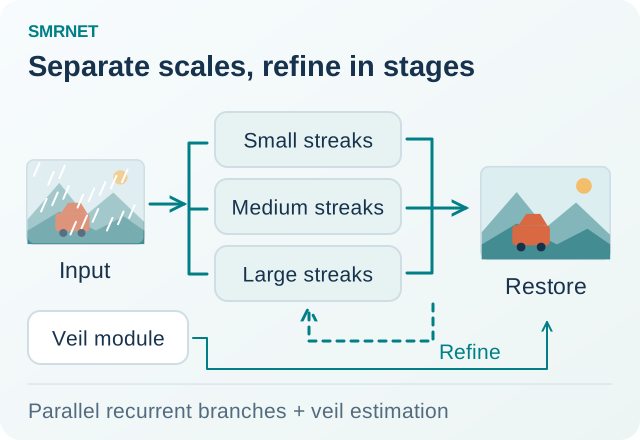
| multiscale-derain.svg | arXiv:1712.06830v1, §4.1–4.2, Fig. 5 | Parallel recurrent subnetworks estimate small, medium and large streaks, with stage-wise refinement and a parallel veil module. DenseNet feature extraction is omitted to keep the thumbnail legible. |
# paper link. Its existing image and entry were left unchanged, as requested.The bio now lists Senior Applied Scientist at Microsoft, retaining Amazon and ByteDance as previous roles. The SVP entry uses the accepted title Feedback-Driven Vision-Language Alignment via Sampling-based Visual Projection, TMLR 2026, the OpenReview link and the published author order. Submission number 8150 is not presented as a publication identifier.